
Affiliate Disclosure: Power Station Zone is reader-supported. When you buy through links on our site, we may earn an affiliate commission at no extra cost to you. Our evaluations are based on published specifications, manufacturer data and verified owner reports.
Introduction
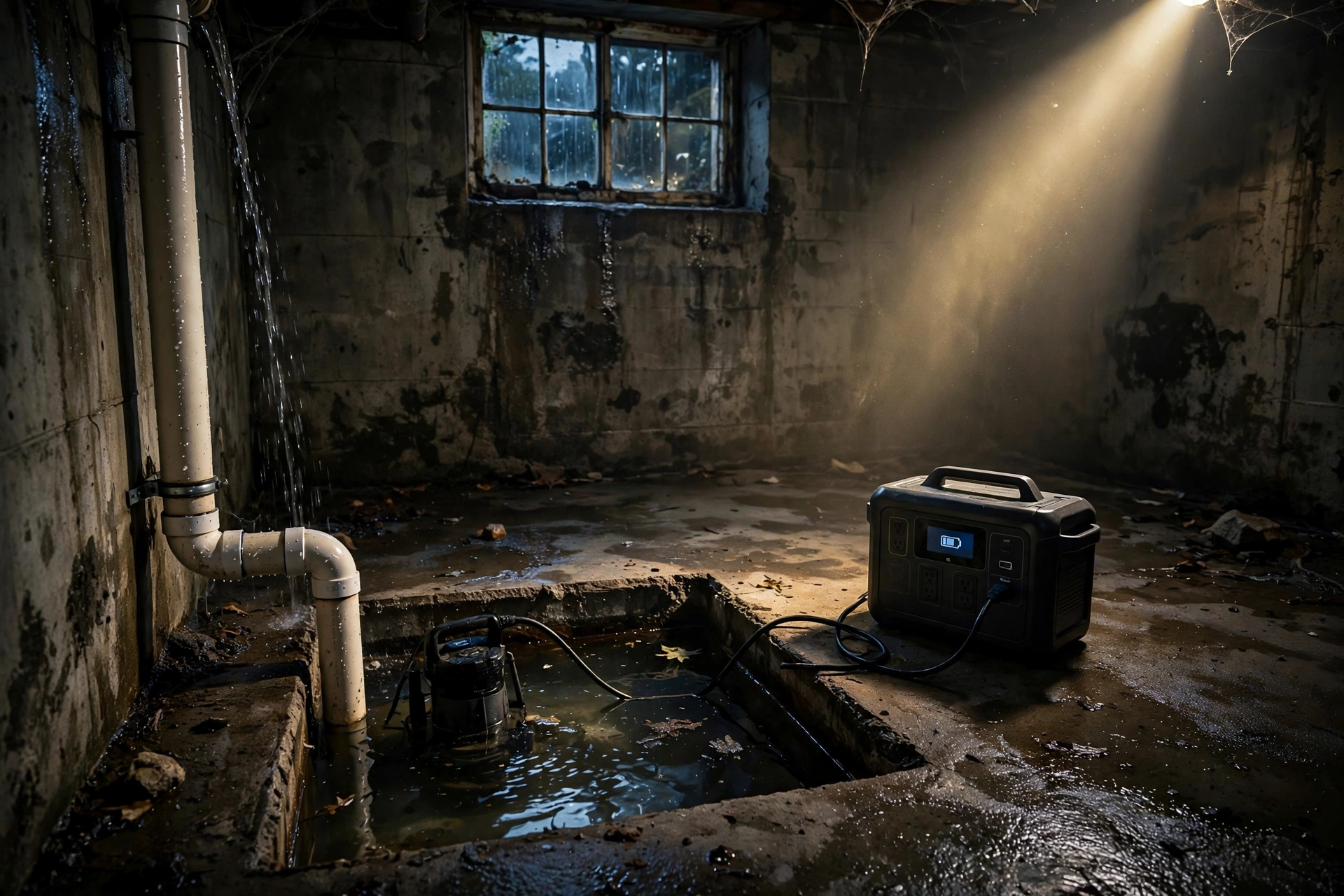
A sump pump only matters on the worst day of the year — the storm that knocks out power is the same storm filling your pit. A gas generator works, but it has to be dragged out, fueled and started in the rain. A power station sitting next to the pit starts instantly and silently. The real question is runtime, and sump pumps are trickier than fridges because of one number most people ignore: the startup surge.
Step 1: Your pump’s two watt numbers
Every sump pump has a running wattage and a much higher starting (surge) wattage, drawn for a fraction of a second each time the float switch kicks in:
- 1/3 HP pump: ~800W running, ~1,300–1,600W surge
- 1/2 HP pump: ~1,050W running, ~1,800–2,200W surge
- 3/4 HP pump: ~1,300W running, ~2,400W+ surge
Your power station’s inverter must beat the surge number, or the pump will trip the station’s overload protection on the first start. That rules out most small stations for anything above a 1/3 HP pump. A 1,800W-output station (EcoFlow DELTA 2 class) handles a 1/3 HP pump comfortably. For a 1/2 HP pump, step up to a 2,400W-output model (EcoFlow DELTA 2 Max or BLUETTI AC200L class).
Step 2: The duty cycle is what saves you
A sump pump rarely runs non-stop. In a typical storm it might run 6–15 minutes per hour — a 10–25% duty cycle. Your battery drains at the average draw, not the running watts: Average draw = running watts × duty cycle.
Runtime table (usable capacity = 85% of rated)
For a 1/3 HP pump (~800W running):
| Station size | Pump running | Runtime |
|---|---|---|
| 1,024Wh | Continuously | ~1.1 hours |
| 1,024Wh | 25% duty cycle | ~4.3 hours |
| 1,024Wh | 10% duty cycle | ~10.9 hours |
| 2,048Wh | 25% duty cycle | ~8.7 hours |
| 2,048Wh | 10% duty cycle | ~21.8 hours |
For a 1/2 HP pump (~1,050W running), on a 2,048Wh station:
- Continuously: ~1.7 hours
- 25% duty cycle: ~6.6 hours
- 10% duty cycle: ~16.6 hours
Run your own numbers in our Portable Power Station Size Calculator — set the pump’s running watts and your estimated hours of actual pumping per day.
The honest limits
In a severe storm with constant inflow, a pump can approach continuous running — and then even a 2kWh station buys you only a couple of hours. A battery backup buys time and keeps the basement dry through the typical outage (most storm outages are restored within 2–6 hours); it is not a multi-day solution for a high-water-table home. Pairing the station with a solar panel extends runtime during daylight, and an expandable station (DELTA 2 Max expands to 6,144Wh) is the upgrade path if your pit fills fast.
Our picks for sump pump duty
- 1/3 HP pumps: a 1kWh-class station with at least 1,800W output, e.g. EcoFlow DELTA 2.
- 1/2 HP pumps: a 2kWh-class station with 2,400W output, e.g. EcoFlow DELTA 2 Max or BLUETTI AC200L.
- More options in our pillar guide: Best Portable Power Stations for Home Backup (2026)
FAQ
Can a power station start a sump pump at all?
Yes — if the inverter’s surge rating exceeds the pump’s startup draw. Check both numbers before buying; this is the most common mistake.
Will it damage the pump?
No. Modern stations output pure sine wave power, the same clean waveform as grid power.
How is this different from a fridge?
A fridge’s compressor also cycles, but its surge is far smaller. We cover the math in How Long Will a Power Station Run a Refrigerator?
Leave a Reply